All Saints
LitchamServices
Morning service at 10:15am each Sunday. Additional services for Feasts and Festivals.
About the Church of All Saints, Litcham
Although there is some 13c work the present building is mainly from the later centuries. It underwent a major restoration and expansion following the Black Death at the beginning of the 15c and was re-dedicated on the Feast of St Botolph, 17th June 1412 (exactly 600 years later on 17th June 2012 the church was re-dedicated by the Bishop of Norwich). The village was badly damaged by fire in 1636, which may have destroyed the church thatch and hastened the deterioration of the former tower. The present brick tower was paid for by Matthew Halcott, who was a prosperous local tanner, in 1699. The tower has six bells and a keen band of bell-ringers meet once a month for practice. The clock with faces on the south and west of the tower was restored in 2010 by the newly-formed Friends of All Saints.
The north and south aisle windows, with much of the stonework restored in recent years, show an unusual design of tracery including an X pattern that can also be seen in the church at Carbrooke and at St Nicholas’ Church, King’s Lynn. This can be dated to the early 15c.
The chancel windows have a form of Y tracery, but are not genuine 13c. work and more likely to be from an early 19c. restoration. The east window matches the side windows, but is set into the larger frame of an earlier window. On the north side is a vestry built in 1853.
There is no exterior porch but inside the south door is an inner porch made from some old boards, previously declaring the Ten Commandments; lettering on the ceiling can still faintly be seen.
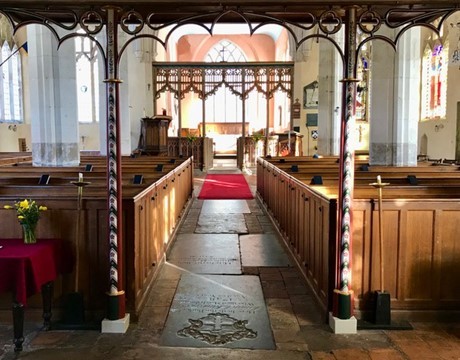
The two arcades have fine 15c. Pillars with slender shafts; the hood moulds above the arches meet above the pillars with carvings of human heads with long wavy hair and pointed beards. There are fine mouldings where the chancel arch adjoins the arcades. The south-west pillar is totally different being octagonal on a square base and may remain from an earlier church. The arches above do not rest centrally on this pillar.
On the central pillar in the south aisle can be found some graffiti, known as the Litcham Cryptogram, which was probably a pilgrim’s prayer. There is evidence of other graffiti within the building. On the south aisle, set in the floor just before the side altar rails, is a large square stone with a floor piscina and draining channels cut into it.
There is a large gallery at the west end of the centre nave, with moulded metal and wooden tracery, held up by iron posts and supporting the organ. This has recently been beautifully restored and painted (2020) to reflect the colours and design of the rood screen. On the east front of the gallery is a set of metal Royal Arms for Queen Victoria. Behind the organ is an Early English window, now blocked by the tower, which could have survived from the church built about 1300.
At the west end of the north aisle is the 15c, octagonal font with hanging shields and nearby a chart of the many ledger stones with names. The original village sign created by Dr Puddy and Mr Cook, both of whom lived in the village, was erected in 1939 after the coronation of King George VI, it shows Matthew Halcott standing by a tanning board with a tanning knife in hand and is displayed on the north wall. The replacement village sign stands just beyond the Post Office in Church Street.
The pulpit is from the 15c, hexagonal in shape and standing on a wineglass stem. It was found in a London junk shop in 1890 and given to the church by the Rev’d W A Keppel.
Older woodwork can be seen in the Litcham Coffer, supposedly one of only five such 14c Flemish chests in this country. More old wood work can be found in the double stall with two misericord seats underneath which are carved heads with forked beads, fashionable from the time of Richard II 1377-1399. One arm rest portrays a fine angel head with its head-dress and wings folded back onto the bench end.
There are modern glass roundels in both the east and north-east windows of the north aisle. In the latter there are fragments of 15c glass in the tracery, including four tiny angels, two with yellow glass and two with blue. The two coloured glass windows in the south aisle are from about 1850 by Ward & Nixon. A fine stained glass panel in the centre section of the North West window installed in 2019 depicts the parable of the Good Samaritan. Originally installed at St Luke’s Church in Cradley Heath (1895) it was donated to All Saints when St Luke’s was demolished, by a Litcham parishioner and descendent of Dr Thomas Standish, in whose memory it was erected.
The chief treasure of this church are the saints painted on the rood screen. This 1436 screen was restored and repainted in 1903 but thankfully the panels were left untouched. Above there is fine cusped tracery to the five ogee arches, with the centre arch being of a double width. Unusually the screen doors are still in position, though their panels have been more scratched out than the other sixteen. At the top of each of the panels is an angel holding up a curtain as a backcloth for the individual saints.
The chancel seems somewhat plain after the interesting items in the nave, but it is light and spacious and has good wood panelling across the east wall, stating “Gloria in excelsis Deo et in terra pax hominibus”. In the north east corner is the door leading to the vestry and a squint through the wall, so the Mass at the High Altar could be seen from what may originally have been a chantry chapel.